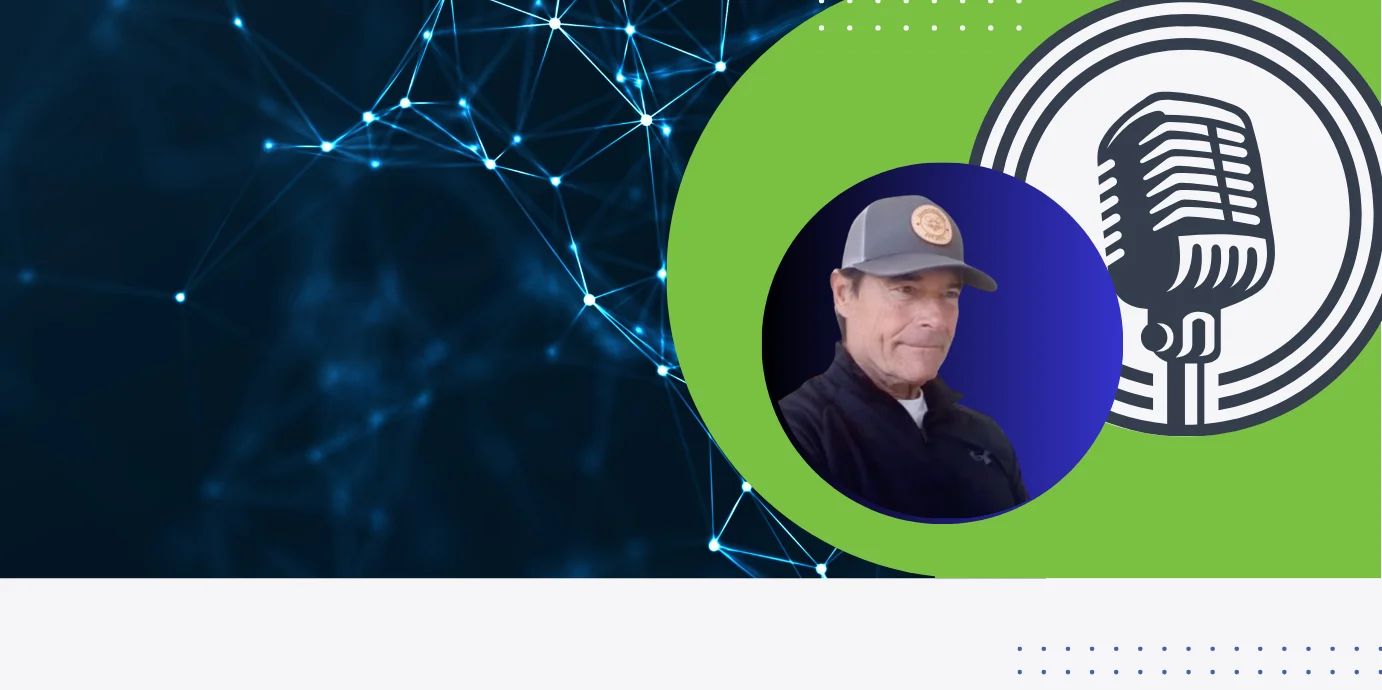
Bradley Shadowens - Episode 165 - The Route to Networking
20 January, 2026
From Curiosity to Compute: Bradley Shadowens on Building AI Data Centres from First Principles
AI infrastructure is being built at unprecedented speed, scale and cost. Behind every GPU rollout and every high-performance compute environment sits a complex web of power, cooling, networking and human decision-making, where small mistakes can have outsized consequences.
In this episode of The Route to Networking podcast, host Ben Davies is joined by Bradley Shadowens, a data centre infrastructure specialist working at the sharp end of AI and high-performance computing. With over a decade of experience across hyperscale, government and financial environments, Bradley has worked on everything from electrical power systems and fibre networks to large-scale GPU deployments.
Now operating in the AI infrastructure space as a bare-metal engineer, Bradley shares what it really takes to design, deploy and scale modern data centres in an industry that is still finding its footing. From self-directed learning and systems thinking to risk, responsibility and craftsmanship, this is a wide-ranging conversation about how cutting-edge infrastructure is built, and what kind of engineers will thrive in the years ahead.
Discipline, Reality and Consequence: Foundations That Matter
Bradley’s background in electrical and computer engineering, including time spent in the US Navy, shaped more than his technical skills. It fundamentally influenced how he approaches responsibility and risk.
“It teaches you that you can be wrong, and consequentially wrong. Not just once, but wrong in sequence, where small mistakes cascade into much bigger problems.”
Working with live electrical systems and mission-critical infrastructure instilled a deep respect for reality. In these environments, errors are not theoretical. They affect safety, uptime and assets worth millions of dollars.
“You’re constantly reminded that you’re working on equipment worth millions. Being wrong in front of a price tag changes how you think.”
This grounding, Bradley explains, is essential for anyone working on the data centre floor. It builds patience, discipline and the ability to troubleshoot calmly under pressure, traits that are non-negotiable in modern infrastructure environments.
The Rise of the Autodidact
One of the strongest themes throughout the episode is Bradley’s belief in self-directed learning. Formal education can open doors, he says, but it will not carry you through an entire career.
“The future belongs to the autodidact. The ability to teach yourself is one of the most valuable skills you can ever develop.”
Bradley intentionally learned how to learn, using technical manuals, industry standards, patents, vendor documentation and construction as-builds to deepen his understanding well beyond what university programmes typically provide.
“Almost everything you want to learn exists somewhere, until you reach the bleeding edge. And even then, you can usually work it out from first principles.”
In fast-moving environments like AI infrastructure, where hardware cycles are measured in months rather than years, the ability to independently research, validate and apply knowledge is a major advantage.
Learning by Tracing the System End to End
When asked how engineers can make sense of complex environments without becoming overwhelmed, Bradley offers surprisingly simple advice.
“Use your index finger. Start at the source, power, fibre, cooling, and trace it through the building.”
By following systems end-to-end, engineers begin to understand how individual components interact, why redundancies exist and where failure points may emerge. Bradley encourages people to look up every symbol on a drawing, identify the manufacturer, understand specifications and trace how each element connects to the next.
“If you do that 25 to 50 times, you’ll know more about your field than most people graduating with professional licences.”
With modern AI tools, this process has become even more accessible, allowing engineers to analyse diagrams, compare vendors, understand cost constraints and explore real-world deployments faster than ever before.
Why Systems Thinking Beats Silos
Bradley cautions against siloed thinking, which often develops in large, specialised organisations.
“There are people who are excellent at subsections of data centres, but blind to how the whole system works.”
While specialisation has its place, Bradley believes the most valuable engineers understand how electrical, mechanical and optical systems interact.
“If you’re 50 to 75 percent useful across power, cooling and networking, you’re extremely hireable.”
This systems-level thinking allows engineers to anticipate second- and third-order problems, design more resilient environments and communicate effectively across teams. As data centres grow more complex, this ability to connect the dots is becoming increasingly rare and increasingly valuable.
AI Infrastructure: Where the Stakes Get Serious
Today, Bradley works in AI infrastructure environments where the financial stakes are on a completely different scale.
“Each GPU chassis can cost between $300,000 and $500,000. And people are ordering them in batches of 72.”
In this context, preparation is critical. Modern AI deployments require extensive upfront compatibility checks across power, cooling, networking and vendor ecosystems. A single oversight can delay deployments by weeks or introduce six-figure remediation costs.
“Six hours of due diligence is nothing compared to botching a $50 million deployment.”
Bradley describes long, deliberate technical discussions within his team before any hardware is ordered or deployed. These conversations are about mitigating risk in an environment where even small mistakes are magnified by scale.
“That preparation is the difference between day-one success and six figures of avoidable problems.”
A Young Industry Finding Its Way
Despite the enormous investment flowing into AI data centres, Bradley is clear that the industry is still young.
“We’re in blue ocean. There are no real guideposts yet.”
With limited historical reference points, mistakes are inevitable. What matters most is how organisations respond to them.
“Every mistake should be educational. You should understand what failed, why it failed, and what else it affected.”
At his organisation, junior engineers are given responsibility early, alongside strong expectations around curiosity, enthusiasm and ownership.
“I don’t want to motivate someone to think supercomputers are cool. You should show up excited to work on this technology.”
Correction, Bradley explains, is often more valuable than punishment, provided people take responsibility and actively learn from what went wrong.
Culture, Curiosity and Craftsmanship
Beyond technical ability, Bradley places enormous value on culture. He describes teams where curiosity is shared, questions are encouraged and knowledge is freely exchanged.
“It has to be shoulder to shoulder.”
This culture supports rapid learning, collaboration and resilience in an industry defined by constant change. Bradley is clear that while skills can be developed, mindsets cannot.
“The skill set can be negotiable. The mindset is not.”
Visibility, Portfolios and Standing Out
For engineers early in their careers, Bradley strongly encourages visibility.
“Record everything. Anything you’ve put your hands on is experience.”
Rather than relying on abstract CV bullet points, he advises engineers to create tangible portfolios that show real work, whether through diagrams, anonymised project examples or written reflections.
“People don’t understand what data centres look like. Give them something they can visualise.”
This approach, he says, consistently opens doors and creates opportunities that formal credentials alone cannot.
Degrees, Credentials and the Changing Career Path
Bradley does not dismiss degrees outright, but he challenges the idea that university is the default or best route for everyone.
“Degrees are useful if there’s no other way to prove credentials. But we don’t live in that world anymore.”
With access to professional communities, online platforms and modern tools, motivated individuals can build credible portfolios and deep expertise independently.
“If you’re the kind of person who digs on your own anyway, technology has given you the tools to prove you’re good at a thing.”
The Skill That Outlasts Every Technology Cycle
When asked what engineers should focus on to stay ahead, Bradley’s answer is consistent.
“Learn how to reward your own curiosity. Learn how to teach yourself.”
In an industry where hardware evolves annually and documentation lags behind reality, self-education is not optional.
“The technology will change. The mindset has to stay.”
A Quick-Fire Round Worth Listening To
To wrap up the episode, Bradley takes on our quick-fire round, offering instinctive, no-filter responses that perfectly reflect his mindset and experience at the sharp end of AI infrastructure.
Without giving anything away, he shares his thoughts on:
- The biggest shift he believes is coming next in AI infrastructure
- Where energy, cooling and power generation are heading
- What excites him most about the future of high-performance computing
- The skill he believes engineers consistently underestimate
- And one final piece of advice that neatly brings the entire conversation full circle
It’s a fitting close to a wide-ranging discussion and a must-listen for anyone curious about where data centres, AI infrastructure and engineering careers are really heading.
Listen to the full episode of The Route to Networking podcast to hear Bradley’s answers in full and explore what it really takes to build the infrastructure powering the AI revolution.
Connect with Bradley on LinkedIn here.
Related Posts

Gary Cudmore - Episode 172 - The Route to Networking
25 March, 2026
The Data Center Talent Crunch in the USA
18 March, 2026